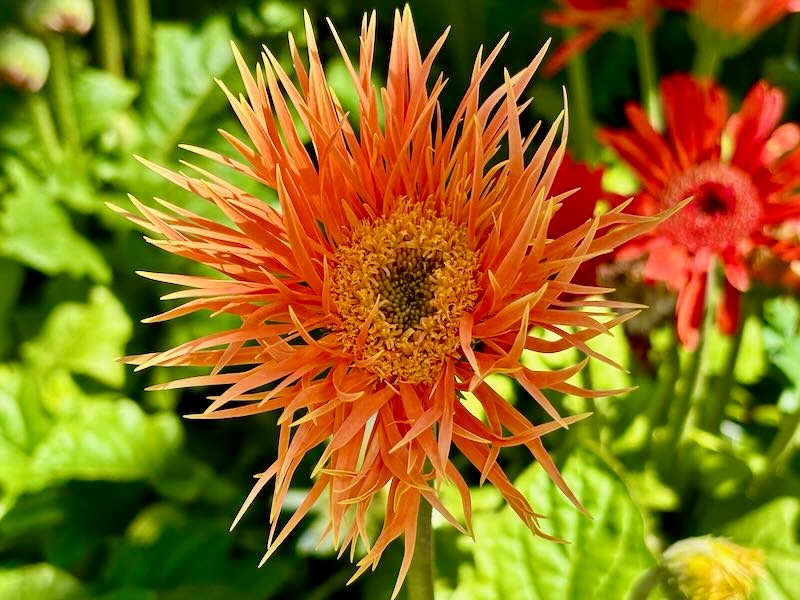

A Burst of Bold Beauty: Meet Gerbera ‘FloriLine Maxi Spider Orange’
Among the many cultivated varieties, few are as visually striking as Gerbera ‘FloriLine Maxi Spider Orange’, a compact yet showy selection of the species Gerbera jamesonii, which belongs to the Asteraceae family — the same vast and colorful clan that includes sunflowers, asters, and zinnias. What makes this particular Gerbera stand out isn’t just its vivid tangerine-orange hue but the distinctive shape of its blooms, with slender, almost spidery petals radiating out in a starburst of texture and color. There’s something undeniably uplifting about the sight of a Gerbera daisy in full bloom, its bright face turned toward the sun like a garden’s own version of a cheerful smile.
The Story Behind the Bloom
Originally hailing from South Africa, Gerbera jamesonii has long been admired for its dramatic, oversized daisy-like flowers. Through selective breeding, the ‘FloriLine Maxi’ series was developed to create garden-worthy plants that offer the florist-quality flowers Gerberas are famous for, but with more reliable blooming and stronger, compact growth habits. The ‘Spider Orange’ cultivar brings an extra dose of personality to the series, with its intriguing petal form and bright orange tones that stand out whether grown in containers, border fronts, or used as eye-catching cut flowers for vases.
Typically, plants in this series reach a tidy height of around 4 to 6 inches (10 to 15 cm), with a spread of about 3 to 5 inches (8 to 13 cm). While modest in stature, the boldness of the flowers more than makes up for their size, providing gardens with a splash of vivid color that endures throughout the growing season.
How to grow Gerbera ‘FloriLine Maxi Spider Orange’:
Light and Location: As with most Gerberas, ‘FloriLine Maxi Spider Orange’ craves abundant sunlight to fuel its blooms. In regions with cooler summers, full sun is ideal, rewarding the plant with strong, sturdy stems and more prolific flowering. In hotter climates where summer temperatures routinely climb above 85°F (29°C), providing a touch of afternoon shade helps the plant cope, especially when it grows in a container or near surfaces that reflect heat, like pavement or walls. Morning sun and filtered afternoon light offer an excellent balance for keeping the foliage healthy and the flowers coming.
Soil and Drainage: Soil quality and drainage are key to a thriving Gerbera. ‘FloriLine Maxi Spider Orange’ performs best in light, well-draining soil enriched with organic matter such as compost, leaf mold, or peat moss. Avoid heavy clay soils or poorly draining conditions, as standing water around the plant’s crown can quickly lead to rot, a common downfall for Gerberas when grown in the wrong conditions. The ideal soil pH for this variety falls between 5.5 and 6.5, a slightly acidic range that helps ensure optimal nutrient uptake. If your soil is outside of this range, amending with sulfur (to lower pH) or lime (to raise it) can help fine-tune the environment for success.
Watering, Feeding for Continuous Blooms
Watering with Care: Watering Gerberas is always a balance between keeping the roots moist but never saturated. ‘FloriLine Maxi Spider Orange’ prefers its soil to dry slightly between waterings, particularly in cooler weather or when rainfall is plentiful. As a rule of thumb, wait until the top 1 to 2 inches (2.5 to 5 cm) of soil feel dry before watering again. During the height of summer, or if the plant is growing in a container, more frequent watering will likely be necessary. When watering, aim for the base of the plant rather than overhead, as wet foliage can encourage fungal issues, particularly in humid weather or during cool nights.
Feeding: Like many heavy-blooming ornamental plants, ‘FloriLine Maxi Spider Orange’ benefits from a regular feeding schedule to maintain its floral display. Applying a balanced, water-soluble fertilizer once every four weeks during the active growing season will encourage steady bud production and keep the foliage looking vibrant. A formulation with slightly elevated phosphorus levels will further promote abundant flowering.
Overfeeding, particularly with nitrogen-rich fertilizers, can lead to lush leaf growth at the expense of blooms, so moderation is key.
Encouraging Healthy Growth and Reblooms
Deadheading is one of the simplest and most effective ways to extend the blooming period of ‘FloriLine Maxi Spider Orange’. Spent flowers should be removed by cutting the stem back to the base of the plant as soon as they begin to fade. This not only improves the plant’s appearance but redirects energy toward producing new buds.
Along with deadheading, trimming away any yellowing or damaged foliage will improve air circulation and help prevent fungal problems. In humid conditions, giving the plants enough space to breathe is just as important as lighting and water to keep them healthy.
Pests and Problems
While generally trouble-free, Gerberas can occasionally attract aphids, spider mites, and whiteflies, particularly when grown in warm, dry conditions. Regular inspection of the leaves — especially their undersides — will help catch any early signs of infestation. An application of insecticidal soap or neem oil usually resolves these issues before they cause lasting harm.
Crown rot and powdery mildew are the most common diseases that affect Gerberas, and both can be minimized through proper watering habits, good air circulation, and by planting in well-drained soil.
Growing in Containers and Indoors
Gerbera ‘FloriLine Maxi Spider Orange’ is as at home in a decorative pot as it is in the garden. When grown in containers, be sure to use a high-quality, free-draining potting mix and select a container with drainage holes. Container-grown plants tend to dry out more quickly, especially in summer, so monitor soil moisture carefully and water when the top 1 to 2 inches (2.5 to 5 cm) are dry.
Indoors, place your Gerbera in a bright window where it will receive at least 6 hours of sunlight per day. Supplemental lighting from a grow light can help maintain blooming during the shorter days of winter.
Overwintering
In many regions, Gerberas are grown as annuals, especially in climates where winter temperatures dip below 40°F (4°C). However, in USDA Zones 8 to 10, ‘FloriLine Maxi Spider Orange’ can overwinter as a tender perennial, returning each year if protected from hard frost. In colder regions, container-grown plants can be moved indoors for the winter, placed in a bright but cool room, and watered sparingly until spring growth resumes.
Propagation of Gerbera ‘FloriLine Maxi Spider Orange’:
Gardeners usually propagate cultivated varieties like ‘FloriLine Maxi Spider Orange’ through division rather than seed to ensure the new plants retain the parent’s traits. In early spring, you can carefully lift a mature plant and divide its crown into smaller sections, making sure each piece has healthy roots and a portion of the central crown. Replant the divisions in fresh soil to rejuvenate older plants and expand your collection at the same time.
A Final Splash of Sunshine
In the world of garden flowers, few plants manage to balance sculptural precision and joyful color as effortlessly as Gerbera ‘FloriLine Maxi Spider Orange’. With its spidery, vibrant orange blooms and compact, easy-to-grow nature, this little showstopper brings both personality and performance to beds, borders, and patios. Given the right conditions — sun, well-drained soil, and a gardener’s attentive hand — it will reward you with months of brilliant color and cheerful charm.