
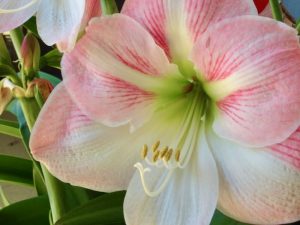
Amaryllis ‘Apple Blossom’: Classic Winter Drama In Soft Pink
Hippeastrum ‘Apple Blossom‘ or Amaryllis ‘Apple Blossom‘ brings romance to winter windowsills and early-spring patios with big, trumpet blooms brushed in blush-pink over creamy white and centered by a fresh lime-green throat. This beloved bulb belongs to the Amaryllidaceae (amaryllis) family and traces its garden popularity to mid-century Dutch breeding. Gardeners prize it for reliable indoor forcing, strong stems, and a bloom show that lasts for weeks. Plant it in a snug pot, give it bright light, and it answers with flowers up to 18–20 cm (7–8 in) across. Because the scapes rise well above the foliage, the display reads clean and architectural—elegant in a single pot and spectacular in groups.
What makes Hippeastrum ‘Apple Blossom’ special
You get size, staying power, and grace in equal measure. The Hippeastrum blooms open in succession, so the show often spans a month or more. The color reads like spring apple blossoms—soft pink veining and petal edges over white—with that signature green glow at the throat.
Each bulb typically produces 2–3 flower stalks (scapes), each bearing 3–6 trumpet flowers. Stems reach 45–60 cm (18–24 in) tall on a mature bulb, yet they stand stout and rarely flop if you rotate the pot toward the light. Indoors, it brightens short days; outdoors in mild climates, it slots neatly into late spring beds. The plant’s rhythm—growth, bloom, leafing, rest—makes it one of the easiest bulbs to enjoy year after year.
Hippeastrum ‘Apple Blossom’ at a glance
Amaryllis ‘Apple Blossom’ is a tender perennial bulb for indoor winter bloom or outdoor beds in warm regions. Expect glossy, strap-like leaves 2.5–4 cm (1–1.5 in) wide that arrive with or just after the first scape. The plant grows from a tunicate bulb roughly 8–12 cm (3–5 in) across at retail; larger bulbs generally give more scapes. Outdoors it’s hardy in USDA Zones 8–11; gardeners in colder zones treat it as a seasonal houseplant and store it for a rest before the next bloom cycle. All parts of Hippeastrum contain alkaloids; keep bulbs and cuttings out of reach of pets and children.
Flowering season for Hippeastrum ‘Apple Blossom‘
Time bloom to your calendar. When you pot a fresh Hippeastrum ‘Apple Blossom’ bulb in late autumn, it typically flowers 6–8 weeks later, so a mid-November planting delivers flowers around New Year’s. Plant in December for a Valentine’s display. In Zones 8–11, bulbs grown in the ground or containers outdoors naturally bloom from late spring into early summer as days lengthen and nights warm. Cooler nights deepen the pink tones; warmer rooms open the flowers faster, so shift open blooms out of direct sun to extend their life.
Growth habit, size, and form
Hippeastrum forms a neat clump with leaves arching from the neck (the top of the bulb). One to three scapes rise straight, each 45–60 cm (18–24 in) tall and 2–3 cm (¾–1 in) thick. Each scape ends in a cluster of large trumpets 18–20 cm (7–8 in) wide. After flowering, leaves lengthen to 40–60 cm (16–24 in), capturing energy for next year’s show. Indoors, a single 15–18 cm (6–7 in) pot looks balanced; for a mantel or long sill, line up three pots at 20–25 cm (8–10 in) intervals.
Plant family and background
Hippeastrum sits in Amaryllidaceae with Daffodils, Snowflakes, and Snowdrops. Although we casually call it “Amaryllis,” the true genus Amaryllis lives in southern Africa and includes the fragrant Belladonna Lily. Modern Hippeastrum hybrids descend from tropical and subtropical species native to Central and South America. ‘Apple Blossom’ joined the trade in 1954 and still ranks among the most requested pink types because it bridges vintage charm and modern performance.
How to Grow Hippeastrum ‘Apple Blossom‘
Set yourself up for predictable, showy bloom by matching the plant’s natural cycle. Pot, bloom, leaf out, feed, rest, and repeat.
Light
Place Hippeastrum or Amaryllis ‘Apple Blossom’ bright and steady. During active growth and bud formation, give bright, indirect light—a sunny east or south window works well. Aim for 10,000–20,000 lux if you use a light meter. Outdoors in spring, choose morning sun and afternoon shade. Once the first flowers open, pull the pot slightly back from intense sun to slow fading. Rotate the container a quarter turn every few days until the buds open so stems grow straight.
Soil
Use a free-draining, airy mix. Blend equal parts high-quality potting mix, fine bark, and perlite, or choose a commercial “cactus and succulent” base and add 25% composted bark. Target pH 6.0–7.0. In heavy garden soils, plant in raised beds or large containers instead; wet, cold clay invites bulb rot.
Potting and depth
Choose a pot just 2–5 cm (¾–2 in) wider than the bulb. Depth matters: set the bulb so the top third sits above the soil line. Press soil firmly around the roots to anchor the bulb, then water once to settle. A heavy ceramic cachepot helps prevent tipping as the tall scapes rise.
Watering
Water with intention. After planting ‘Apple Blossom’, water once and wait until you see 5–8 cm (2–3 in) of growth. Then keep the mix evenly moist but never soggy, watering when the top 2–3 cm (¾–1¼ in) feels dry. Expect to water every 5–7 days indoors at 18–21 °C (65–70 °F). Good drainage is non-negotiable; tip out any water standing in saucers.
Fertilizing
Feed for flowers, then feed for the future. While the scape elongates and flowers open, lightly feed every 2–3 weeks with a balanced, half-strength liquid (for example 10-10-10 at half label rate). Once flowering finishes and the leaves expand, switch to a slightly higher-potassium feed (such as 5-5-7 or tomato food at low rate) every 3–4 weeks through late summer. Stop fertilizing about 6 weeks before you plan to start dormancy.
Temperature and humidity
Aim for 18–24 °C (65–75 °F) in bud and bloom. Cooler nights around 15–18 °C (59–64 °F) slow opening and deepen color. Avoid drafts from doors and heat vents, which can twist stems. Humidity between 30–50% suits most homes. If air runs very dry, place the pot on a pebble tray with water below (not touching) the pot base.
Staking and support
Thick scapes usually stand without help, but a slender stake and soft tie keep stems safe in high-traffic rooms. Insert the stake as the scape reaches 20–25 cm (8–10 in) to avoid piercing a swelling bud.
After-flowering care (re-bloom routine)
Once the last bloom fades, cut the hollow flower stalk to 2–3 cm (¾–1¼ in) above the bulb without nicking the leaves. Grow the plant like a foliage houseplant in bright light. Leaves power next year’s flowers, so keep them healthy and unblemished. In late summer or early autumn, prepare for a rest:
- Option A: Cool-rest method (fastest re-bloom). In early autumn, stop feeding and reduce water. When the leaves yellow naturally, cut them off cleanly and move the pot to a cool, dark place at 10–13 °C (50–55 °F) for 8–10 weeks. Keep the soil barely dry—just a sip once a month. After the rest, bring the pot back to warmth and light, refresh the top 2–3 cm (¾–1¼ in) of mix, water, and restart the cycle. Expect bloom 6–8 weeks later.
- Option B: Leafy carry-over (milder climates). In Zones 8–11, grow the bulb outdoors in bright shade from late spring to early autumn. Water during dry spells and feed monthly. In late autumn, pot it and bring it indoors to restart the bloom cycle without a full leafless rest. Bloom timing is less precise but still reliable.
Hippeastrum ‘Apple Blossom’ outdoors
If you garden where winter lows stay above –12 to –7 °C (10–20 °F) (Zones 8–9), you can plant ‘Apple Blossom’ bulb outdoors in a sheltered bed. Set bulbs with the neck just above the surface and mulch 5 cm (2 in) deep with coarse bark. Choose a spot with morning sun and sharp drainage. In frost-prone nights, cover sprouting buds with a cloche or overturned nursery pot.
Design ideas for Amaryllis ‘Apple Blossom‘
Indoors, line three identical clay pots along a console for a clean, gallery feel. For a classic winter vignette, underplant with trailing ivy or Baby’s Tears, leaving the bulb’s neck exposed for air flow. Pair with white Cyclamen or Paperwhites for layered fragrance and texture. On a spring porch in mild zones, cluster containers of ‘Apple Blossom’ with Hellebores and Ferns; the soft pink plays beautifully with cool greens and ivory.
Safety and handling
The ‘Apple Blossom’ bulb and sap can irritate skin. Wear gloves when dividing or trimming. Keep bulbs and spent scapes away from cats, dogs, and horses; ingestion can cause digestive upset.
Propagation: how to make more Hippeastrum
You have two easy routes: offsets and twin-scales. Seed is slow and variable, so skip it if you want identical ‘Apple Blossom’ flowers.
Offsets (the simplest). Mature bulbs form bulblets at the base. After the foliage has died down and the bulb completes its rest, slide the root ball from the pot. Gently tease away the outer mix and look for thumb-sized offsets with their own roots. Twist or cut them free with a clean, sharp knife, dust the cut with powdered sulfur if you wish, then pot each offset in a small 10–12 cm (4–5 in) pot with the neck just exposed. Grow them on in bright light. These youngsters usually need 2–3 years to reach flowering size.
Twin-scaling (for the adventurous). With a very sharp, sterile knife, cut a dormant bulb vertically into 8–16 wedge pieces, each wedge containing a portion of basal plate. Dust with fungicide, tuck into slightly damp vermiculite in a ventilated bag, and keep warm (20–24 °C / 68–75 °F). Tiny bulblets form along the cut edges in 8–12 weeks. Pot them carefully and grow on. This method multiplies stock quickly but demands sterile technique.
Pests & Diseases
Red blotch / leaf scorch (Stagonospora curtisii). Look for red streaks or lesions on leaves, scapes, or bulb scales. Prevent with good air flow, bright light, and careful watering (keep water off the neck). Remove and discard affected tissues. Severe infections may require a labeled fungicide; always follow local guidance.
Bulb and root rot. Overwatering and cold, wet mix cause trouble. Use free-draining media, never bury the bulb, and water only when the top layer dries. If rot appears, unpot, trim to healthy white tissue, dust with sulfur, and repot in fresh mix.
Mealybugs and scale. Inspect leaf bases and the bulb neck. Wipe early colonies with cotton swabs dipped in isopropyl alcohol. For heavier infestations, use insecticidal soap at label rate; repeat weekly until clear.
Aphids, spider mites, and thrips. Aphids cluster on buds; blast them off with a firm stream of water, then follow with soap if needed. Mites stipple leaves in hot, dry rooms; raise humidity and rinse leaves. Thrips can scar petals—keep plants away from open garden doors during bloom.
Fungus gnat larvae. These feed on roots in soggy media. Let the top 3 cm (1¼ in) dry between waterings and use yellow sticky cards. A biological control (Bacillus thuringiensis var. israelensis) in irrigation water helps break the cycle.
Hippeastrum ‘Apple Blossom’ timing guide for holidays
- For Christmas–New Year blooms: pot in early to mid-November at 18–21 °C (65–70 °F).
- And for Valentine’s Day: pot in late December.
- Or for Easter (variable date): count back 8–10 weeks from the holiday and pot then; give slightly cooler nights to hold buds if they form early.
If buds race ahead of schedule, move the plant to a cooler, bright room (15–18 °C / 59–64 °F). If growth seems slow, nudge the temperature up a few degrees and check that light is adequate.
Uses: where Hippeastrum ‘Apple Blossom’ shines
Indoor focal point. One bulb can carry a small table. For a dining centerpiece, place three pots in a shallow tray of moss and tuck in cut Magnolia leaves.
Cut flowers. Cut scapes when the first bud just shows color. Recut the base, split the stem 2–3 cm (¾–1¼ in) for water uptake, and stand in deep, clean water with floral preservative. Flowers last 7–10 days in a cool room.
Mild-climate beds. In Zones 9–11, cluster bulbs near north- or east-facing foundations where soil stays warm and drained. Space bulbs 20–25 cm (8–10 in) apart.
Troubleshooting for Hippeastrum ‘Apple Blossom‘
Tall, floppy stems. Light is too low. Move to brighter light and rotate the pot. Stake if needed.
Leaves but no flowers. The bulb didn’t store enough energy or skipped a cool rest. Grow leaves longer in bright light, feed regularly, and provide a defined resting period.
Buds abort or fail to open. Sudden temperature swings or overwatering are common culprits. Stabilize conditions; water only when the top layer dries.
Yellow leaves right after bloom. Normal if you’re heading into rest. If it’s mid-season, check for nutrient shortage and light levels.
Red streaks on scapes. Suspect red blotch. Improve sanitation, keep the neck dry, and remove affected tissue.
Step-by-step: repotting Hippeastrum after rest
- Wake it up. Bring the pot from cool storage to a bright, warm room at 18–21 °C (65–70 °F).
- Refresh the mix. Slip the bulb from the pot. Remove loose old mix and trim dead roots.
- Choose the right pot. Pick a container with drainage, 2–5 cm (¾–2 in) wider than the bulb.
- Set the depth. Seat the bulb so its shoulders sit one-third above the surface.
- Water once. Settle the mix with a single thorough watering. Then wait for visible growth before watering again.
- Rotate to straighten. Quarter-turn the pot every few days until buds open.
Companion ideas
While buds swell indoors, underplant the pot with Moss, trailing Ivy, or small ferns for a finished, florist look. When you display several pots, stagger heights on books or risers. Outdoors in mild zones, combine with Hellebores, Heucheras, and spring bulbs. The soft pink of Amaryllis ‘Apple Blossom’ pairs beautifully with dusky blues and silvery foliage.
Final care calendar for Hippeastrum ‘Apple Blossom‘
- October–November: Pot bulbs for winter bloom; water once; place bright and warm.
- December–March: Enjoy flowering; keep evenly moist; feed lightly.
- March–August: After flowering, grow on leaves in bright light; water when top 2–3 cm (¾–1¼ in) dries; feed every 3–4 weeks. Outdoor summering in Zones 8–11 is ideal.
- September–October: Reduce water; stop feeding; allow leaves to yellow naturally.
- October–December: Rest bulbs cool and dry for 8–10 weeks. Then restart for the next bloom cycle.
With this rhythm, Amaryllis ‘Apple Blossom’ rewards you year after year. Plant it in a firm-sided pot, place it in bright light, and treat the foliage as your flower factory. Do that, and those soft-pink trumpets will return on schedule, right when you want a little drama most.