
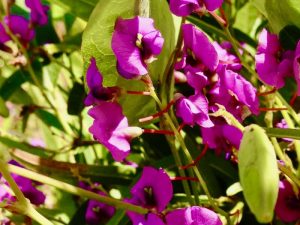
Purple Vine Lilac With Extra Stamina: Hardenbergia violacea ‘Canoelands’
Hardenbergia violacea ‘Canoelands’ bursts into winter with cascades of mauve-purple pea flowers when most vines are asleep. Often sold as Purple Vine Lilac, Lilac Vine, False Sarsaparilla, or Purple Coral Pea, this Australian native turns cold months into bloom season and then keeps going into spring. The selection ‘Canoelands’ stands out for a longer, heavier display than many garden forms, all on an evergreen twining frame that covers fences and pergolas with ease. It asks for sun, a lean, free-draining soil, and something to climb. In return, it gives you months of color, low water needs once established, and a neat, leathery leaf canopy that reads tidy year-round.
Plant family and origin
This vine belongs to the pea family, Fabaceae. Like many legumes, Hardenbergia forms a partnership with soil bacteria to fix nitrogen, so it thrives in soils that would starve fussier plants. The species is native to southeastern and southwestern Australia, where it ribbons through bushland and across coastal scrub. The cultivar ‘Canoelands’ is a garden selection of Hardenbergia violacea that nurseries began circulating in the late 2000s. Gardeners noticed it flowered longer than popular forms such as ‘Happy Wanderer’, often carrying trusses well into late spring.
What sets Hardenbergia ‘Canoelands‘ apart
You will spot the difference in winter. While many lilac vines finish by early spring, ‘Canoelands’ keeps dangling fresh trusses for weeks after. The leaves also help you tell it apart: they are narrower and a touch squarer at the tip than those of ‘Happy Wanderer’, yet still dark green and leathery. In bloom, each pea flower flashes a chartreuse “eye” at the center, a nectar guide for pollinators on bright, cool days. The show is generous but not gaudy—exactly the kind of color most gardens crave in February and March.
Flowers, foliage, and form
The flowers are classic pea-blossoms arranged in pendent racemes. From mid-winter into spring, you’ll see clusters 10–15 cm long (4–6 in) along the newest growth. Individual blooms are a rich mauve to purple with that signature greenish-yellow spot. In cool snaps, color deepens; in warmer spells, it softens. Because trusses arise on a rolling schedule, you get layers of fresh bloom instead of a single flash.
Leaves are evergreen, simple, and tough. Expect blades 5–10 cm long (2–4 in), glossy on top and paler beneath. They hold well in wind and salt-tinged air, which makes the vine a strong choice near the coast. Stems twine rather than cling, so the plant wraps itself around supports without adhesive pads or tendrils.
Bloom season and fragrance
Flowering usually starts in mid-winter and can continue to late spring—often from June to September in the Southern Hemisphere and from January or February through May in many Mediterranean and warm-temperate climates. Compared with other forms, Hardenbergia violacea ‘Canoelands’ stays “switched on” longer, sometimes still producing trusses when others have finished. The flowers are lightly sweet on warm winter afternoons. Bees and early hoverflies work them eagerly, grateful for nectar when little else is out.
Size, growth rate, and training options
Given a trellis or fence, Hardenbergia ‘Canoelands’ climbs to 3.5–5 m (12–16 ft) and spreads 1.5–2 m (5–6½ ft). Growth is quick once roots settle. In mild zones you can also run it as a groundcover to quilt a bank. It will root lightly where stems touch soil, thickening coverage over time. Left untrained, the base can go bare as flowers and leaves stack toward the light. A simple annual trim solves that, promoting new shoots down low.
Where Hardenbergia ‘Canoelands’ fits in the garden
Use it where you want winter drama with minimal upkeep. It’s excellent on a sunny fence, draped over a lightweight arbor, or spiraled up a pergola post. If your patio feels empty in cold months, train a pair up an entry arch and enjoy a curtain of color at eye level. Garden designers also set it on banks for erosion control, weaving it among grasses and silver foliage shrubs. In coastal gardens, the vine tolerates wind and occasional salt drift; give it a few meters inland from direct spray and it will reward you with vigor.
How to Grow Hardenbergia ‘Canoelands‘
Light
Plant it where it receives full sun to light shade. Aim for at least 5–6 hours of direct sun for the strongest flowering, especially in winter when the sun sits low. In hot inland climates, protect it from harsh late-afternoon sun in summer with light shade from a high tree canopy or a west-side screen. Too much shade leads to fewer trusses and a thinner habit.
Soil
Give it free-draining, moderately fertile soil. Sandy loam suits it best, but the vine tolerates clay if you improve drainage. Work 5–8 cm (2–3 in) of coarse compost or fine pine bark into the top 20–25 cm (8–10 in) of soil across the planting zone. Target a pH from 5.8 to 7.2. Avoid heavy additions of phosphorus; as an Australian native in the pea family, Hardenbergia prefers low-to-moderate P levels and will make much of its own nitrogen.
Watering
Water to establish, then lean toward deep and infrequent. In the first season, soak the root zone once or twice a week in warm, dry spells—about 15–20 L (4–5 gal) per plant each time, depending on soil. Once established, the vine becomes drought tolerant and often needs only rainfall in coastal or Mediterranean climates. In long hot spells, a deep drink every 10–14 days keeps leaves glossy and flower buds forming. Always allow the top 5–8 cm (2–3 in) of soil to dry between irrigations; soggy ground invites root trouble.
Fertilizing
Feed lightly. In early spring, top-dress with a 2–3 cm (¾–1¼ in) blanket of compost around the drip line. If growth looks lean, apply a slow-release, low-phosphorus fertilizer labeled for natives at the lowest label rate. Skip high-nitrogen feeds; they push leaf over flower. Because the plant fixes nitrogen, it usually thrives with compost alone in decent soil.
Temperature and hardiness
Hardenbergia ‘Canoelands’ suits USDA Zones 9–11. It tolerates brief dips to about –4 to –6 °C (20–25 °F). Flowers take light frost in stride, though hard freezes can mark tender tips. In marginal areas, site the vine against a radiant wall with southern or eastern exposure, mulch the root zone 5–7 cm (2–3 in) deep, and protect young plants with frost cloth on the coldest nights.
Pruning and training
Start training at planting. Provide a sturdy trellis, wire grid, or tensioned cables, and spiral the main stems upward. Use soft ties and adjust them as stems thicken. After the main bloom finishes, prune to shape. Shorten flowered laterals by one-third to one-half to trigger fresh shoots lower down. If the base becomes bare, cut one or two older stems back hard to 30–45 cm (12–18 in) right after bloom; new shoots will fill in. Avoid heavy pruning late in autumn—tender regrowth is more vulnerable to frost.
Mulching and weed control
Mulch pays off. Lay 5–7 cm (2–3 in) of shredded bark or leaf mold across the root zone, keeping it 5 cm (2 in) off the stems. The mulch cools soil, suppresses weeds, and reduces watering. In dry regions, a drip line beneath the mulch gives the most efficient irrigation and keeps foliage dry.
Containers and small-space culture
You can grow Hardenbergia violacea ‘Canoelands’ in a 40–50 cm (16–20 in) pot with a tall obelisk or trellis. Use a coarse, bark-rich potting mix and ensure generous drainage. Water when the top 3–4 cm (1¼–1½ in) of mix dries. Feed sparingly in spring with a low-P, slow-release fertilizer. In cold snaps below –4 °C (25 °F), drag the pot against a sunny wall or into a bright, frost-free space.
Design ideas with Hardenbergia violacea ‘Canoelands‘
Harness its winter show where you see it every day. A pergola near the kitchen door becomes a seasonal focal point with the vine braided up two posts and lightly draped across a beam. On modern fences, train it horizontally along stainless cables for tidy ribbons of bloom. For cottage borders, let Hardenbergia violacea ‘Canoelands’ mingle with Correa, Westringia, and Grevillea cultivars that enjoy similar conditions. Silver foliage plants—such as Helichrysum and Olearia—make the mauve trusses pop. As a slope cover, weave it between rocks and drought-tough grasses. It will soften hard edges and hold soil through winter rains.
Propagation of Hardenbergia ‘Canoelands‘
Cuttings keep the selection true. Take semi-ripe tip cuttings 7–10 cm (3–4 in) long in late summer or after flowering. Remove lower leaves, nick the base, dip in a rooting hormone for semi-hardwood, and stick into a sterile 1:1 mix of perlite and fine bark or peat. Provide bright shade, bottom warmth around 21–24 °C (70–75 °F), and consistent humidity. Rooting often takes 6–8 weeks. Pot on gently; Hardenbergia dislikes rough root handling.
You can raise Hardenbergia from seed, but Hardenbergia violacea ‘Canoelands’ will not come true. If you’re curious, nick the seed coat or pour near-boiling water over seeds and soak overnight to break dormancy. Sow in a free-draining mix and keep just moist at 18–21 °C (65–70 °F). Inoculating with a native legume rhizobium at sowing can boost early vigor, especially in sterile mixes.
Pests and diseases on Hardenbergia ‘Canoelands‘
Hardenbergia violacea ‘Canoelands’ is generally tough. In the open garden, you may see only minor nibbling. The main issues arise from poor drainage or stale air.
Root problems appear first as a plant that wilts despite wet soil. If you notice that, lift a spadeful and check drainage. Raise the planting area if needed and ease off watering. In greenhouses or sheltered patios, watch for glasshouse whitefly and spider mites in warm, still spells. A firm water rinse and a targeted application of insecticidal soap or horticultural oil usually resolves early infestations. Snails and slugs can graze young shoots at ground level; copper tape around container rims or simple hand-picking at dusk protects new growth.
Sooty mold on leaves points to sap-suckers like scale or aphids. Treat the insect, then rinse the black residue away. Powdery mildew is uncommon in full sun with good airflow; if it appears after an unusually humid spell, thin the canopy lightly after bloom and avoid overhead watering.
Seasonal care calendar for Hardenbergia ‘Canoelands’
Late summer to autumn (August–October in warm temperate climates): Plant new vines so roots settle before winter bloom. Install supports at planting. Mulch the root zone. In dry regions, give a deep soak every 10–14 days.
Winter (November–January): Enjoy the early trusses. Check ties and guides after wind events. Water only if winter is unusually dry; the goal is evenly moist, never wet, soil.
Late winter to early spring (February–March): Peak bloom. As trusses fade, prune to shape and to bring growth lower. Top-dress with compost. If growth seems sparse, apply a light dose of a low-phosphorus, slow-release fertilizer.
Mid to late spring (April–May): New shoots extend. Train stems along their supports. If the base looks bare, select one or two older canes and cut them back hard to stimulate fresh shoots. Water deeply during dry spells.
Summer (June–August): In inland heat, provide afternoon shade from high sun if possible. Deep-water as needed. Avoid heavy pruning now. Watch for mites or whiteflies in still, hot weather and address early.
Troubleshooting: quick fixes that work
If flowering is light, increase sun exposure and ease up on nitrogen. Often a simple move from bright shade to morning sun turns an average vine into a winter standout. If the base goes bare, time your pruning right after bloom and cut a few old canes hard to push new growth down low. If leaves yellow while veins stay green, check drainage first; water-logged roots struggle to pick up nutrients. Lighten the soil, then feed sparingly once new growth begins.
At-a-glance facts
- Common names: Purple Vine Lilac, Lilac Vine, False Sarsaparilla, Purple Coral Pea
- Botanical: Hardenbergia violacea ‘Canoelands’ (older sources list Hardenbergia monophylla)
- Family: Fabaceae
- Form: Evergreen, twining vine; can be used as a groundcover
- Size: 3.5–5 m high × 1.5–2 m wide (12–16 ft × 5–6½ ft) with support
- Bloom: Mid-winter to late spring; mauve to purple trusses 10–15 cm long (4–6 in)
- Light: Full sun to light shade (afternoon shade in hot interiors)
- Water: Low once established; deep, infrequent soaks
- Soil: Free-draining; pH 5.8–7.2; low-to-moderate phosphorus
- Cold: Down to about –4 to –6 °C (20–25 °F) with protection
- Uses: Fences, pergolas, arbors, banks, large containers, coastal gardens
The final word on Hardenbergia ‘Canoelands‘
Plant it where winter sunshine hits, give it something sturdy to climb, and keep its roots in airy, well-drained soil. Tie new stems early, prune right after bloom, and mulch generously. Do those simple things, and Hardenbergia violacea ‘Canoelands’ will repay you with months of lilac-purple flowers when the garden needs them most, followed by a year-round cloak of clean, evergreen foliage. It is the kind of vine that makes a fence feel intentional, a pergola feel finished, and a small winter garden feel generously alive.